
Bakersfield Night Sky — February 7, 2026

Tickets for the first show of the spring season at the William M Thomas Planetarium “Moon Base” on February 19 are now available through the Vallitix site. The Mesmerica shows are sold through the Mesmerica site.
Jupiter continues shining very brightly in the east in the evening among the stars of Gemini. To the right of Gemini is Orion with orange-red Betelgeuse and blue-white Rigel at diagonally opposite ends. Following Orion’s Belt downward, you’ll come to Sirius. Nearly overhead above Orion is Taurus with orange Aldebaran at its eye and the beautiful cluster, the Pleiades, at its shoulder. Leo is now just beginning to rise in the evening, telling us that spring is coming soon. Blue-white Regulus is at the base of the backward question mark (the Sickle) that makes up the lion’s head and chest. At the other end of Leo is white-hot Denebola at the end of the lion’s tail.
Low in the west, the ringed planet Saturn is visible below the Great Square part of Pegasus until about 8:15 or 8:20 p.m. In about two weeks, we’ll begin to see Mercury and Venus low in the southwest just after sunset but you may need binoculars to pick them out from the twilight glow. On February 18 a very thin waxing crescent moon will be right next to Mercury. The moon will be so close to Mercury that those in the southeast part of the United States, Mexico, and most of Central America will see the moon cover up Mercury.
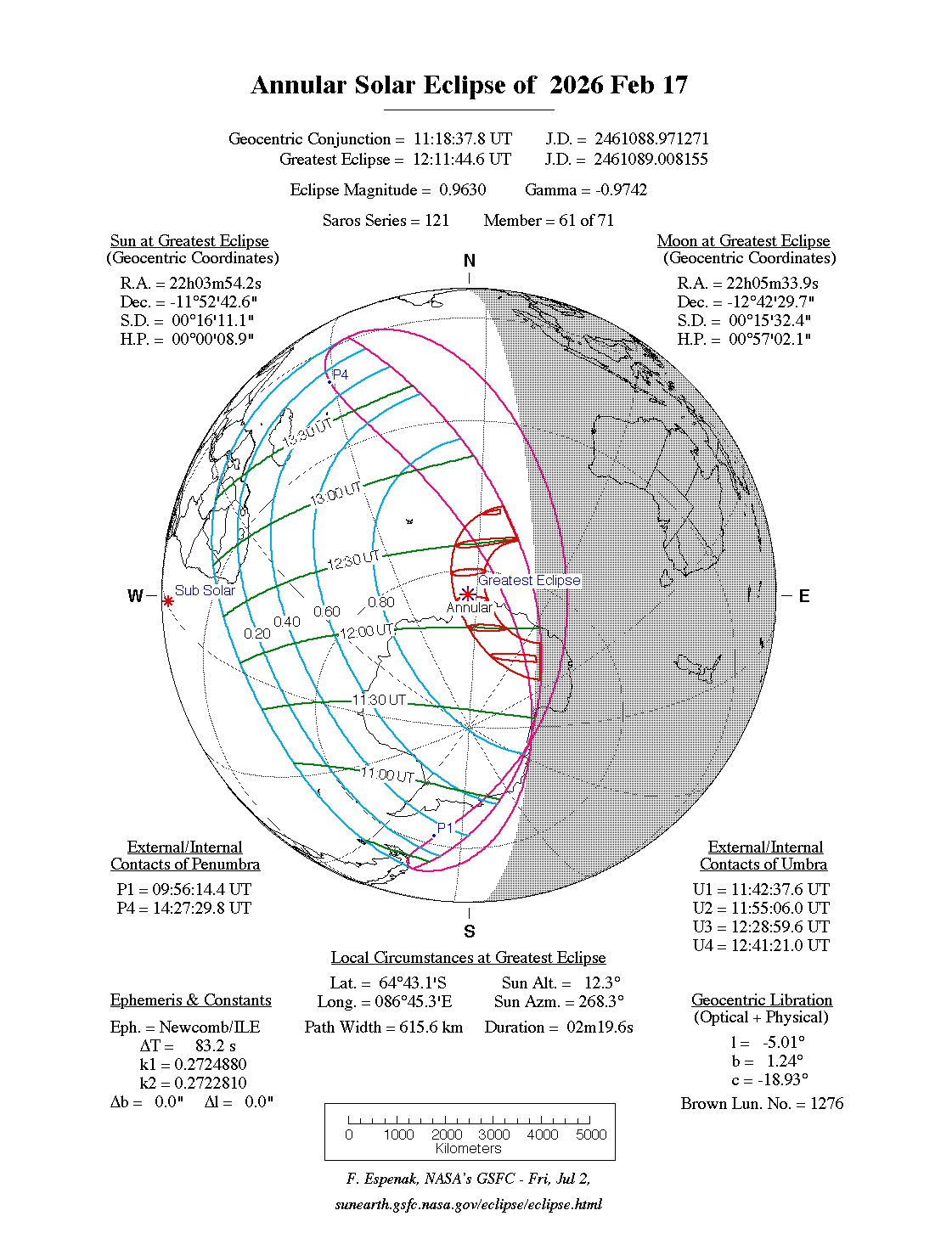
The day before (February 17), the moon will be at New phase and lined up with the sun to make a solar eclipse. Unfortunately, the moon will be near the farthest part of its elliptical orbit around Earth, so it will be just an annular eclipse with about 93% of the sun’s surface blocked by the moon. Also, unfortunately, the annular solar eclipse is visible only from the coast of Antarctica.
Tonight, the moon is a waning gibbous rising a bit past midnight. It will be at Third (Last) Quarter phase the following night. Early risers on February 11 will see a fat waning crescent moon to the lower left of the orange-red heart of Scorpius, the supergiant star Antares. The two will easily fit within the same field of view of your binoculars. Start looking low in the southeast at about 3:15 a.m.
Last week, a team of astronomers announced the discovery of an Earth-sized exoplanet orbiting at the edge of a nearby star’s habitable zone. The exoplanet is called “HD 137010 b”. The HD comes from the Henry Draper catalog of 225,300 stars over the entire sky with brightnesses brighter than ninth magnitude. The catalog was created over a century ago. HD 137010 b orbits its star in 355 days. The star is about 1000 degrees cooler than the sun, so the exoplanet is at the outer edge of the habitable zone, making it be Mars-cold.
The exoplanet is part of the database of stars observed by the now-defunct Kepler space telescope that found thousands of exoplanets using the transit method. If an exoplanet’s orbit is aligned edge-on with respect to us, we can see the exoplanet cross in front of—transit—the star, slightly dimming the star light. The bigger the exoplanet, the more starlight that is blocked. The closer the exoplanet orbits to the star, the more frequent are the transits.
HD 137010 b was discovered by a “citizen-science” project called “Planet Hunters”. Volunteers analyze data from the Kepler and the TESS mission. With over half a million stars to examine, we need all the help we can get! The exoplanets discovered by the computer algorithms use multiple transits to hone in on the precise orbital characteristics. HD 137010 b has had just one transit that we’ve observed, so it’s technically a candidate exoplanet and its orbit parameters are a bit fuzzy. There’s a 40% chance that it could actually orbit closer to its star and be more comfortable than the current estimate.
Although Kepler did find some rocky Earth-size exoplanets in the habitable zones of warm Sun-like stars, HD 137010 b is the first one that orbits a star close enough to us (and therefore, bright enough) for substantial follow-up observations—observations that could reveal atmospheres and whether life has altered the atmosphere, i.e., clear biosignatures. It will definitely be a target for the Terra Hunting Experiment detector on the Isaac Newton Telescope on the island of La Palma and the European Space Agency’s PLATO space telescope that is going to launch in about a year.
PLATO is short for “PLAnetary Transits and Oscillations of Stars” (okay, drop the “S” because there can be only one PLATO). While Kepler and TESS have been able to find small rocky worlds, they’ve been in close orbits around much cooler stars. They haven’t been able to easily find true Earth twins. PLATO will be able to do that, so we’ll soon know for sure how common or rare it is for Earth-size planets to orbit around warm sun-like stars.
—
Director of the William M Thomas Planetarium at Bakersfield College
Author of the award-winning website www.astronomynotes.com
